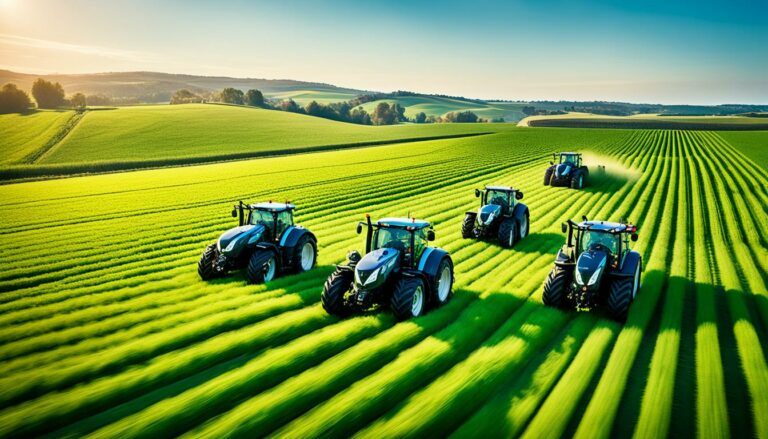

The agriculture robots market is forecasted to grow massively. It could reach over $40 billion by 2028 from $13.5 billion in 2023. This shows a huge change in farming. North America leads currently because of its wide use of automation. This tells us a lot about where farming is headed with technology and automated planting.
Robot-assisted planting is quickly becoming very important in farming, especially in precision agriculture. It makes things more efficient, improves what we can grow, and reduces waste. This is crucial as we will need to feed 9.7 billion people by 2050. Using robots, from self-driving tractors to drones with AI, is key to meet this need.
Robot-assisted planting is a key part of how we use robots in farming. It mixes automated tools with the latest in AI and machine learning. This combination makes planting crops easier and more sustainable. And it’s very important as more people will need food in the future. By 2050, we expect the world’s population to rise from 8 billion to 9.7 billion. So, we need new ways to farm food.
Robot-assisted planting uses machines to put seeds and plants in the ground. It uses AI, machine learning, and advanced sensors for accurate planting. This tech can change how it plants based on the weather and soil conditions. This helps farmers grow more food and make less waste. Machines also never get tired and can keep working every day. They’re a great help when there aren’t enough people to do the job.
Farmers started using robots in the 1950s when industrial robots first appeared. But, it’s only recently that we’ve really started to use them in farming. We are moving from old ways of farming to new, high-tech methods. This change is because we need more food and we want to farm in ways that keep our planet healthy.
In the history of robot farming, the most money has gone to robots that harvest crops. Next are robots that milk cows. Companies both new and old, like Naïo Technologies and John Deere, are focusing on these robot solutions. The amount of money we spend on robot farming is growing fast. In 2022, it was over $6 billion. By 2030, it’s expected to go up to $18 billion. This shows how important robots are becoming in farming.
Robots are essential in modern agriculture. They boost productivity and ensure we farm in ways mindful of the planet. Their efficiency and accuracy cannot be overlooked.

Robots really ramp up how much we produce on the farm. They do tasks much faster than people can. Imagine ten workers’ speed, controlled just by two, but three times quicker. An example is the RoboWeeder2, which plants seeds on 0.4 acres in an hour. This speed reduces costs and ups our harvests. They also cut the need for pesticides by 80% by applying them very precisely.
But it’s not just about speed. Robotics help us farm sustainably. They can tell a plant from a weed using advanced sensors and GPS. This stops us from overusing chemicals. They also spot when fruits are ready to pick, making harvesting more efficient. This smart way to farm helps the planet and cuts waste. It supports big goals like using fewer chemical pesticides by 2030, set by the European Green Deal.
Advancements in precision agriculture are changing how we plant our crops. Key technologies include AI, machine learning, sensors, and data systems. These tools make planting more efficient, sustainable, and accurate.
AI and machine learning are making farming operations smarter. Carbon Robotics’ LaserWeeder, for example, tells weeds from crops using AI and computer vision. This improves crop quality and cuts costs.
Nexus Robotics’ R2Weed2, an autonomous weed-killing robot, also stands out. It uses AI to pick out weeds from the soil. This helps with soil analysis and environmental checks. These examples show how AI and machine learning are changing agriculture for the better.
Sensor tech keeps an eye on things like soil moisture, nutrients, and weather. It gives instant data that makes farming more effective. For example, Bowery Farming combined sensors with AI and robotics. This cut the water use for herbs and leafy greens by 90-95%. Such accurate data use makes sure crops get what they need, helping agriculture be more sustainable.
Good data management is vital in farming. AppHarvest uses AI, robots, and careful growing to boost crop yield and save water on their indoor farms. Advanced systems let farmers sift through lots of data. This helps make smart decisions and runs agriculture smoothly, boosting productivity and care for the environment.
The face of farming is changing with the rise of robots in precision agriculture. In the past five years, agricultural robotics has seen a large growth. It makes farming more efficient and profitable.
The demand for these technologies is high due to less available labour, more people wanting food, and higher farm costs. This pushes for more smart farming solutions.

Robots in farming have made a big difference, increasing farm output and making work easier for people. Robotnik, for example, has led over 60 research projects since 2002. Its work covers logistics, health, and the food industry, all to make work processes better.
“Robots in agriculture are revolutionising the sector by enhancing precision, reducing waste, and automating tasks that were previously labor-intensive,” notes a leading researcher.
Traditional farming tends to waste up to 99% of chemicals, just spraying them everywhere. Robots that work precisely with plants can stop this waste, using resources better. Here are some new ideas:
Devices like the AutoProbe by AgRobotics show big steps forward. It can check 150 acres in an hour, updating data every 45 seconds. BoniRob is also a key tool for faster plant data analysis for breeders.
Projects like BACCHUS, AGROBOFOOD, and COROSECT are pushing digital change in farming. They work on things like better farm checks and picking, aiming for eco-friendly and efficient food making.
One big benefit is how these robots manage weeds and apply plant food carefully. This cuts crop losses from weeds by more than half. Investments in this area are growing. This is because new high-tech robots are making farming more accurate and effective.
Automated planting brings several cost-effective farming perks. It uses technology to streamline farming tasks. The global spending on robotic farming exceeded $6 billion in 2022. This figure is set to triple by 2030, showing a big push towards modern agriculture.
One key gain of automated planting is cutting down on labour costs. With the world’s population expected to hit 9.7 billion by 2050, we need to produce food more efficiently. Automated systems, with their advanced robotics, lessen the need for people-power in farming. This not only solves labour scarcity issues but cuts the cost for farmers too, making farming more cost-effective.
Automated planting is highly efficient. Robotic systems work tirelessly, improving farming accuracy. They cut down on waste and boost harvests with exact methods. Precision seeding, for example, places seeds optimally using digital tools. This shows how automated planting can increase farm output while being eco-friendly.
Real-time data collection is a game-changer for automated planting. With the use of sensors and data tools, these systems monitor soil, weather, and crop status. This allows for quick, smart choices from farmers. Farms can now react fast to changes, ensuring better crop care and more productivity.
In wrapping up, automated planting is pivotal for today’s farms. It offers significant cost-effective farming benefits and boosts efficiency and sustainability. By lowering labour costs, enhancing efficiency, and offering real-time data, the agriculture field is set to tackle worldwide food needs. It also helps in saving resources and limiting harm to the environment.
The use of robotic seeders in farming is a big step forward in technology. These robots use advanced GPS and sensors to plant seeds very accurately.

Robotic seeders rely on technologies like Lidar and GPS for precise movement on any land. They map the planting area very accurately. This allows them to adjust to the soil and land as they plant, making sure each seed has a great chance to grow.
Robotic seeders are used in all sizes of farms, from big ones to smaller, detailed ones. Take the robot forester, for example. Made by Milrem Robotics, it can plant a lot of trees in just a few hours, which is important for places affected by deforestation.
Smaller farms also benefit by planting their crops very carefully. These methods lead to better crops and use of resources. Big projects, including one funded with a $2.4 million EU grant, show these technologies’ potential. Tools like the LaserWeeder, from Carbon Robotics, use AI to tell weeds from crops. This improves the quality of the crops and cuts costs.
Companies like Naio Technologies introduce robots like Ted for vineyards. These machines show the wide use of robotic seeders in farming. They fit with many crop types and land conditions. Robotic seeders play a key role in farming’s future, caring about precision and the environment.
Smart farming IoT is becoming very popular. It shows the world’s increasing interest in advanced technology in farming. IoT improves data collection and use. This makes farms work better and be kinder to the environment. Farming with IoT means using data to do things. This includes running the farm more smoothly and making more things.
Robotics play a key part in smart farming. They help with many tasks, like planting and spotting ripe fruits. By adding IoT to these robots, farmers can do more tasks automatically. This includes watering crops and protecting them from pests. This mix of tech saves time, money, and makes farming more precise. It cuts waste and raises crop amounts.
IoT sensors measure things like temperature and air quality. They give farmers real-time data. This data helps farmers make smarter choices for their crops. Using this data, farmers can grow crops better. They can also use fewer pesticides, which helps the earth. This smarter use of data is good for the environment and the food we eat.
| Aspect | Benefit | Challenge |
|---|---|---|
| Automation | Time and cost savings through efficient task management | High initial costs for implementing IoT technology |
| Data Collection | Informed decision-making and improved crop management | Complexity in data interpretation and requirement for technical expertise |
| Environmental Impact | Reduction in greenhouse gas emissions and improved soil fertility | Compatibility issues due to lack of standardisation |
IoT and robotics working together make farm work better and more effective. There are some challenges, like the cost to start and needing skilled people. But, the big win is how farming improves with all this data. This is key to use IoT well in farming.
Recently, autonomous agricultural machinery has become very common in farming. It’s powered by AI and machine learning. This kind of technology is expected to be in high demand. It reduces the cost of hiring and training workers. Farmers can save money on operation costs because of this.
This technology changes how fields are managed. It makes planting, taking care of crops, and collecting them much better. For example, John Deere showcased a driverless 8R tractor at the CES show. This tractor can work without someone driving it. Farmers can control it from a phone or a computer. This means they can do more work without having to always be there themselves.
It helps crops grow better and makes them of better quality. It does this by choosing the best time to harvest using AI. By using several machines, farmers can make more food. This way of farming is also better for the planet. It uses less harmful chemicals and water. It also uses the land smarter. This helps agriculture be more responsible.

By 2027, this technology is expected to be a $95 billion market. More people will need food by 2050. Robotics in farming help with that. They make farming safer and more comfortable. They bring less exposure to harmful substances. They also make farming in tough conditions easier.
Robotic planting has many advantages. But, the high costs and complex technology stop it from being used widely. It is vital to find ways to fix these issues. This will let us make the most of this new farming technology. Later, I’ll talk about the robotic planting challenges and how to solve them.
The big cost at the start is a major setback. Buying the latest robots and adding AI can be very expensive. This mostly affects small and medium farms. A study by Wang et al. showed a device they made for picking tomatoes worked well, but it was not cheap. Luckily, some help is available, like an $840,000 grant from the National Science Foundation. It shows we still need money to cut these early costs.
Getting robots to plant is not easy. It needs a lot of skill in mechanics and software. Farmers often need help to set up these technologies. They also need to keep the robots working properly. A study by Deshmukh et al. on a machine for spraying pesticides showed how complex the control needs to be. Using AI, like deep learning and fuzzy logic, makes it even more so. This is to make sure robots, such as those for studying plants, work well.
Many need to work together to solve these tech issues, including researchers, engineers, and farmers. Making the technology easier to use can help a lot. Scientists are working on making robots smarter and more robust. They are even trying to make these robots get their power like real plants do. This will help the robots work better, even when the conditions are tough.
| Robot | Mode of Locomotion | Success Rate |
|---|---|---|
| Seeding robot for wheat | Four wheels, servo motors, stepper motors | 93% |
| Tomato picker | Flexible end effector | 86% |
| Pesticide spraying robot | Fuzzy control system | Precision spraying |
Robot planting has its challenges but could really change farming for the better. Solving the issues of cost and complexity will lead to more sustainable and efficient farming.
Robot-assisted planting has shown how technology can change farming for the better. A notable project used robots to weed and plant, leading to healthier crops without harming the environment. This method increases farm output while being eco-friendly.

Robots were also used to restore habitats. They planted trees and spread seeds to help the environment recover. This shows how robots can aid large-scale efforts to save our planet by boosting biodiversity.
Robotic pollinators are helping out as well, especially with the recent bee decline. They keep crop yields up, supporting our need for food. With more tech advancements, our food production can be stable.
In some projects, drones and underwater robots were used to track species and gather data. These tools help protect wildlife by providing important information for decision-making. They play a key role in sustainable and ethical farming.
| Project | Technology Used | Outcomes |
|---|---|---|
| Weeding and Planting | Robotic Weeders and Planters | Reduced chemical use, enhanced crop health |
| Habitat Restoration | Robotic Systems | Efficient tree planting, ecosystem recovery |
| Pollination Assistance | Robotic Pollinators | Mitigated decline of natural pollinators, sustained crop yields |
| Species Monitoring | Drones and AUVs | Enhanced data collection, biodiversity conservation |
These examples show how robots are reshaping agriculture. By using technology well, we can make farming better, help the planet, and spark new ideas in agriculture.
If you want to know more about how robots protect wildlife, check out this article on robots and biodiversity solutions.
Looking ahead, some upcoming agricultural technology trends are on the way. They are likely to change how we farm. For instance, full automation in areas like orchards and vineyards is growing. These systems can bring more than $400 in earnings per acre each year. This shows the clear benefits of upcoming farming ideas.
Right now, the American Southwest is facing its driest period in 1,200 years. This is because of a long-lasting megadrought. It highlights the need for sustainable solutions. Indoor vertical farming is a game-changer. It can cut water use by up to 70% when compared to traditional methods. It’s crucial as the need for food might grow by 70% before 2050, thanks to a big increase in the population.
Prices for things like fertiliser and crop protection chemicals have gone up by 80 to 250 percent worldwide. This makes it even more important to bring in cost-effective new techniques to farming. Semi-automated systems, for example, have cut down on herbicide use by 80% on big US corn farms. This change saved $30 per acre with a payback time of only two years.
But, even with these great benefits, just under 5 percent of farmers in key regions are using high-tech solutions. That’s much lower than the 21 percent using farm management software. So, there’s a lot of room for growth, especially with the precision agriculture market heading towards $43.4 billion by 2025.
Blockchain and AI will also shape the future of farming. Blockchain can make food product tracking better, ensuring a clear and checkable supply chain. AI gives us better understandings of plant health and soil. This makes decisions smarter.
Big investments in agtech companies are pushing the growth of drones, autonomous tractors, robot harvesters, and other automatic tools. These steps will make farming processes smoother. They will also lower labour costs and boost productivity, securing the future of agriculture.
Quadruped robots are changing agriculture with their precise work. They do well in checking soil, planting, and pulling weeds. With these robots, farmers do better and greener work.
One big job for these robots is checking the soil. They have special sensors to measure things like dampness, pH, and heat. This info helps farmers make choices that are good for their crops. The soil analysis robots can figure out the best ways to use things like water and fertiliser.
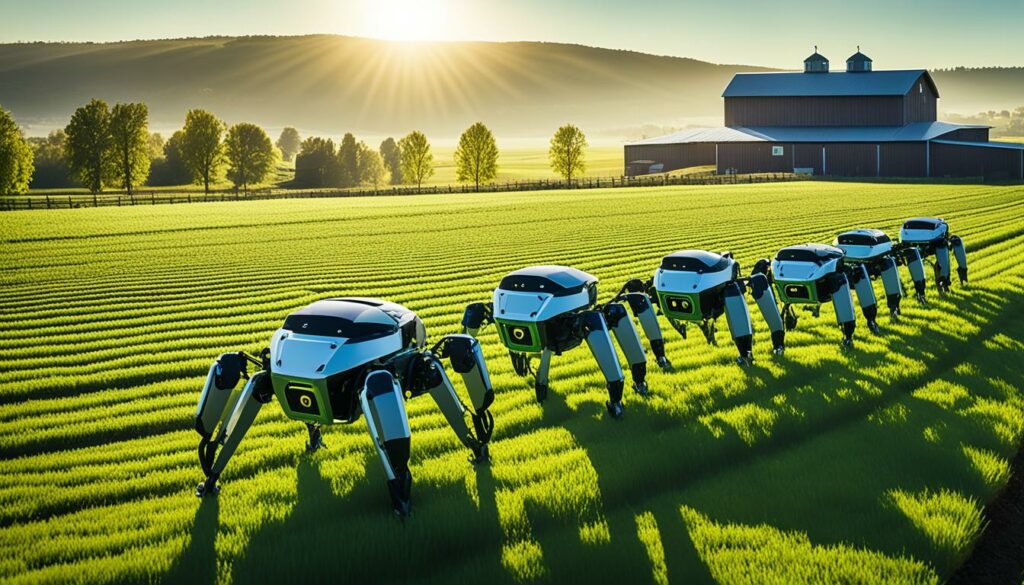
Quadruped robots are also great at planting and getting rid of weeds. They can be very careful and don’t make the soil too hard. This helps crops grow better. Projects like the Vinum Project use these robots to prune grapevines in winter.
So, using quadruped robots in farming really helps. They make work like checking soil and watching crops much better. They help farms be more productive and take better care of the land.
Robotic innovations are changing vertical farming technology. They make farming more efficient and better for the planet. With the help of robots, vertical farms are saving space and using less water and energy. This means more crops can be grown with less work.
Tortuga AgTech’s robots are amazing at picking fruit, hitting a 98% accuracy. They only need one person to oversee them. Bowery Farming uses up to 95% less water thanks to their robot-run greenhouses. This makes vertical farming a top choice for those who care about saving water. AppHarvest uses AI and robots to cut down on water use. They want to reach 70% of Americans with fresh food in just one day.
Robots help with more than just picking. Carbon Robotics’ LaserWeeder uses lasers to kill weeds but not the crops. This cuts down on harmful herbicides. And Nexus Robotics’ R2Weed2 bot is smart. It knows the difference between weeds and crops. It helps farmers know how healthy their soil and crops are. This all means the food we get is better for us.
FFRobotics’ fruit picker is 10 times faster than humans. This shows how robots can really speed things up. They also cut down on how much work is needed. Labor costs can be reduced by 40%. And crop yields can go up by 60%. Thanks to robots, farms need way – up to 95% less – people to work on them.
To sum up, vertical farming technology and robotic agricultural solutions are changing farming for the better. They lead us towards a farming future that’s kind to the earth and very productive.
In recent years, we’ve seen a big drop in the number of natural pollinators. This decline is a serious threat to how much food we can grow. Bees are vital as they help pollinate around 35% of the food crops we eat today. Luckily, we now have robotic pollinators to tackle this problem head-on.

Natural pollinators are becoming scarcer, especially due to changing climates. Honey bees, for example, are crucial for pollinating over 90 crops in the U.S., like apples and almonds. But, climate change is leading to problems within bee colonies, affecting their work. Robotic pollinators, including models like BloomX’s robotic bees, show a lot of promise. They might help increase crop yields by 20% to 40%. This is more than what regular honey bees can do.
New crop pollination technology is making big strides. For instance, Arugga’s robotic pollination bots are performing as well as, or even better than, bumblebees in some cases. These bots can be adapted for different crops, which makes the whole pollination process better. Another example is RoboRoyale, which focuses on keeping the queen bee healthy. A healthy queen bee leads to more efficient pollination.
StickBug from West Virginia University is making waves thanks to a $750,000 grant from the U.S. Department of Agriculture. It features six arms, making it more effective at pollinating crops like blackberries and tomatoes. Since about 80% of plants that flower need animals to help them pollinate, these robots could be a game-changer. They address the current pollinator crisis and could help farmers earn more.
| Feature | Natural Pollinators | Robotic Pollinators |
|---|---|---|
| Pollination Accuracy | Variable | High and Controllable |
| Crops Pollinated Annually | 90+ (Honey Bees) | Customizable Per Crop |
| Impact of Climate Change | Significant | Minimal |
| Increased Crop Yield | Baselines Vary | 20% to 40% More |
| Operation Period | Seasonal | Year-Round |
The success in producing greenhouse tomatoes all year in the U.S. highlights the need for reliable pollination. Robotic pollinators play a vital role here. They are not just good for farming. Initiatives like the one at WVU also use them to teach students about the latest in robotics.
The blend of robotics and agriculture is changing the way we farm. This change brings more efficiency, productivity, and helps the environment. Machines now do tasks like planting and harvesting on a big scale. They cut down on waste and meet the needs of more people around the world.
Tech will keep getting more important in farming. For example, robots with help from AI might farm on Mars soon. They could grow enough food for five years at a place called Milankovič Crater. This shows the hard work in making farming work in space and on Earth.
Also, things like smart planting tools, self-driving farm machines, and systems that use the internet are making farming better. Scientists say using the right genes, perfect light, and backups will keep us growing food well on Mars. All these efforts show how much work and care go into the future of farming. This future is all about using new ideas for sustainable farming here and in space.
Robot-assisted planting uses high-tech machines and tools like AI. It aims to make planting more efficient. It leads to better crops and less waste.
Robots in farming started back in the 1950s. But, they really made progress in recent years. This growth is because we need to grow more food without harming the planet.
By doing boring jobs, robots make farming faster and more precise. This means more crops and less waste. They’re changing how we farm for the better.
Robots plant and use resources just right, stopping waste. This keeps the planet healthier. Farming with robots is better for the environment.
AI helps make farming decisions smarter and faster. It guesses what crops need and uses resources well. This boosts how much food we can grow.
Sensors watch the soil, weather, and plants. They give farmers the facts they need to do better. This technology is key for modern farming.
Robots are for planting, watching over crops, looking after animals, and fighting pests. They do farm jobs perfectly. This helps farming be the best it can be.
Automated planting cuts down on work costs and boosts speed. It helps farmers make quick choices with real-time info. This leads to better farms.
Robotic seeders plant exactly using GPS. They fit different kinds of farms. They’re great for big farms and small, careful ones too.
IoT and robots together collect lots of data. This data helps farmers choose the best actions. It helps make growing food easier and more effective.
Autonomous vehicles change how we farm by doing tasks without a driver. They make planting and harvesting better and safer. They’re also good for a farm’s budget.
High costs and tricky technology are big issues. We need to solve these to use robots more. This needs new ideas and cheaper tech.
Yes, many real-life cases show that planting with robots works well. They make farming more efficient and kind to the earth.
The future is all about more automation and better ways to use data. We’ll see more machines doing the work. They will also help farms be greener.
Quadruped robots are great at checking the soil and collecting data. They’re very skilled, which helps with planting and weeding. They make the land healthier and more productive.
Vertical farming uses robots to grow crops in small spaces. These robots make growing food very efficient. They help get lots of healthy food while saving on work.
Robotic pollinators help plants make fruit by acting like bees. They are very good at their job. They are extra helpful where there aren’t enough real bees.